The Endocannabinoid System: How Cannabis Works in Your Body
What is the endocannabinoid system? How CB1 and CB2 receptors, endocannabinoids and enzymes work, and why THC and CBD affect everyone differently.
By Bloom Team
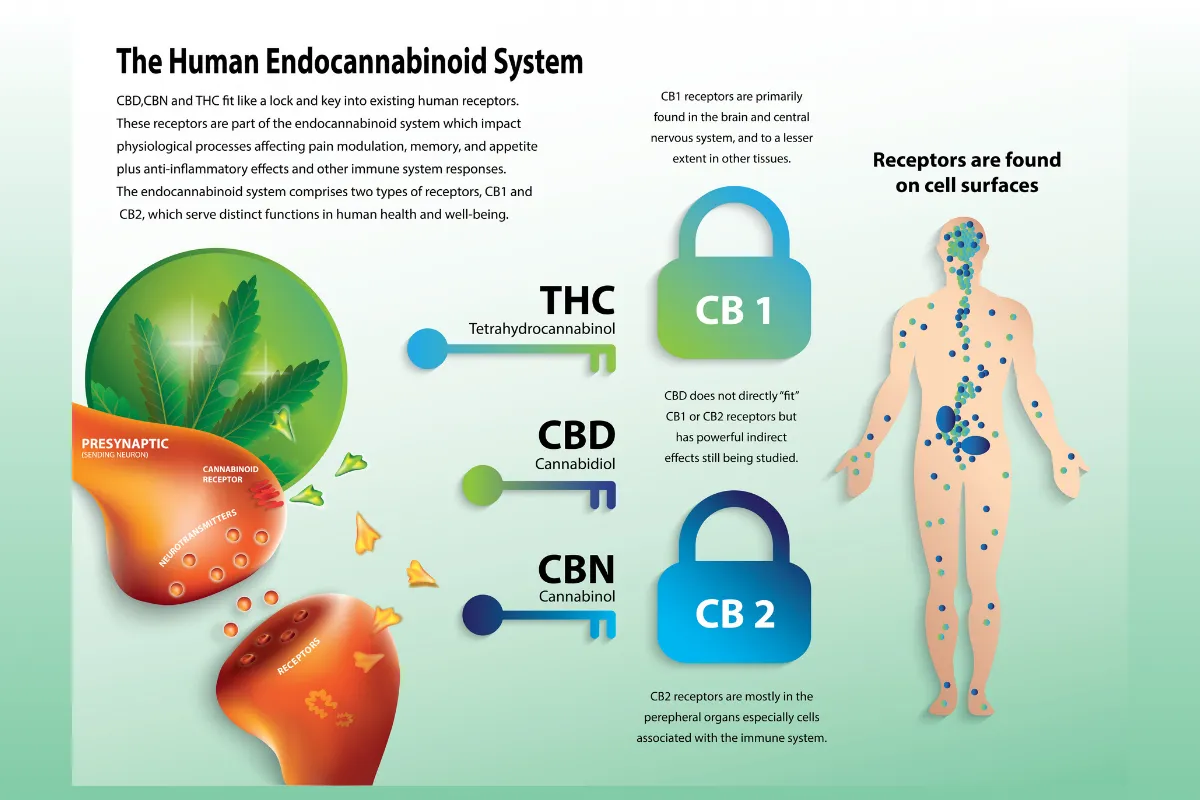
Your body has a built-in system that interacts with cannabis. It existed for millions of years before anyone rolled a joint. It’s called the endocannabinoid system, or ECS, and it’s one of the body’s major regulatory networks, involved in balancing everything from mood and memory to appetite and sleep. Understanding the ECS is the single best way to understand why cannabis affects you the way it does.
What Is the Endocannabinoid System?
The endocannabinoid system is a network of receptors, signaling molecules and enzymes that helps your body maintain homeostasis, the internal balance that keeps everything running smoothly. It was first identified in the late 1980s and early 1990s by researchers studying how THC affects the brain, and it’s now recognized as one of the most widespread signaling systems in the human body.
The ECS was discovered almost by accident. Scientists were trying to work out how THC produced its effects, and in the process they uncovered an entire signaling system the body uses on its own, with no cannabis involved.1 Every vertebrate animal studied so far has one.
The Three Parts of the ECS
1. Cannabinoid Receptors
Receptors are docking stations on the surface of cells. The ECS has two main types: CB1 and CB2.
CB1 receptors are concentrated in the brain and central nervous system. They’re responsible for the psychoactive effects of THC: the euphoria, the altered perception and the appetite stimulation.
CB2 receptors are found mostly in the immune system and peripheral tissues. They’re involved in immune signaling, and they don’t produce a “high” when activated.
2. Endocannabinoids
Your body makes its own cannabinoids, called endocannabinoids. The two best studied are anandamide (named after the Sanskrit word for “bliss”) and 2-AG. These molecules are made on demand when your body needs to restore balance, for example after stress or exertion, and they bind to CB1 and CB2 receptors to trigger a response.
The “runner’s high” people feel after long exercise, for example, is now believed to be driven largely by anandamide, not just endorphins.
3. Enzymes
Once endocannabinoids have done their job, enzymes break them down so they don’t keep signaling indefinitely. FAAH breaks down anandamide; MAGL breaks down 2-AG. This rapid breakdown is part of why the body’s own endocannabinoid signals are subtle and short-lived, and why plant cannabinoids like THC, which those enzymes don’t clear the same way, can produce effects that last for hours.
How Cannabis Interacts with the ECS
Plant cannabinoids, called phytocannabinoids, are shaped similarly enough to your body’s own endocannabinoids that they can bind to the same receptors. THC binds strongly to CB1 receptors in the brain, which produces the classic cannabis high. CBD, by contrast, doesn’t bind strongly to CB1 or CB2 directly. It appears to work by influencing the enzymes that regulate endocannabinoid levels and by interacting with other receptors entirely.2
For more on how these two cannabinoids differ, see our guide to CBD vs. THC. For the lesser-known cannabinoids that also interact with the ECS, see major vs. minor cannabinoids.
What the ECS Is Involved In
The ECS touches nearly every major system in the body. Research has linked it to the regulation of:
- Mood and stress response
- Pain perception
- Appetite and digestion
- Sleep cycles
- Memory and learning
- Immune function
- Motor control
- Reproductive health
Because the ECS is involved in so many processes, cannabis can produce a wide range of effects depending on the strain, the dose and the person. That’s why one person feels relaxed while another feels anxious from the same product.
Endocannabinoid Deficiency: A Working Theory
Researcher Dr. Ethan Russo has proposed a theory called clinical endocannabinoid deficiency, which suggests that some chronic conditions may involve an underactive endocannabinoid system.3 It remains a hypothesis that hasn’t been proven, but it’s one of the more closely watched questions in cannabinoid research.
Why the ECS Matters for Cannabis Consumers
Knowing that the ECS exists, and that it’s your body doing most of the work, changes how you think about cannabis. The plant isn’t forcing effects onto you. It’s activating a system that was already there, and your individual endocannabinoid biology is the reason your experience might be completely different from a friend’s.
This is also why building tolerance, taking breaks and starting with low doses all matter so much. For practical guidance, see our guides to microdosing cannabis, tolerance breaks and the entourage effect.
Frequently Asked Questions About the Endocannabinoid System
Do all animals have an endocannabinoid system?
All vertebrates and many invertebrates have an ECS, which means your dog and cat respond to cannabinoids too. THC is toxic to pets, though, so never share. If a pet gets into cannabis, see what to do if your pet ingests THC.
Can you support your endocannabinoid system without cannabis?
Research suggests some everyday habits influence it. Aerobic exercise raises anandamide levels, and regular sleep and managing stress are linked to healthy endocannabinoid signaling.
Is CBD active in the ECS?
Yes, but indirectly. CBD doesn’t strongly activate CB1 or CB2 receptors the way THC does. Instead, it influences the enzymes that break down anandamide and acts on other receptors, which is why it isn’t intoxicating.
Why do some people get anxious from cannabis and others don’t?
CB1 receptor density, endocannabinoid tone, genetics and metabolism all vary from person to person. A low dose for one person can be too much for another, which is one reason starting low is universally recommended. If you ever feel too high, here’s how to sober up from weed.
Does tolerance affect the ECS?
Yes. Regular, heavy THC use can cause CB1 receptors to downregulate, meaning there are fewer of them available over time. Studies of daily users suggest receptor levels start to recover within about two days of stopping and return close to normal within about four weeks.4
The Bottom Line on the Endocannabinoid System
The endocannabinoid system is the reason cannabis works at all. It’s a regulatory network that helps keep your body in balance, and cannabinoids from the plant interact with it directly. Respecting that system by starting low, taking breaks and paying attention to how your body responds is how you get the most out of every cannabis experience.
Have questions about which products to try? Our budtenders at Bloom Ohio and Maryland can walk you through cannabinoid and terpene profiles in store.
Footnotes
-
Lu & Mackie, 2016. An Introduction to the Endogenous Cannabinoid System. Biological Psychiatry. ↩
-
Pertwee, 2008. The diverse CB1 and CB2 receptor pharmacology of three plant cannabinoids. British Journal of Pharmacology. ↩
-
Russo, 2016. Clinical Endocannabinoid Deficiency Reconsidered. Cannabis and Cannabinoid Research. ↩
-
Hirvonen et al., 2012. Reversible and regionally selective downregulation of brain cannabinoid CB1 receptors in chronic daily cannabis smokers. Molecular Psychiatry. ↩
For general information. This post isn't medical or legal advice. Cannabis rules differ between Ohio and Maryland and can change, so check with the Ohio Division of Cannabis Control or the Maryland Cannabis Administration. Talk to a healthcare provider before using cannabis for a medical condition. For adults 21+ and registered medical patients.
More from the Bloom blog.

Education9 min read
What Are THC Drinks? A Complete Guide to Cannabis Beverages
What are THC drinks? How nano-emulsified cannabis beverages work, how fast they kick in, how they compare with alcohol and edibles, and how to dose them.
Bloom TeamNovember 10, 2026
Education5 min read
Cooking with Cannabis: Butter, Oil and Infusion Basics
Cooking with cannabis: how to decarb, make cannabutter and cannabis oil, estimate the THC in homemade edibles, and simple recipes to start with.
Bloom TeamOctober 30, 2026
Education3 min read
Cannabis Topicals: How They Work and How to Use Them
What are cannabis topicals? How creams, balms, roll-ons and patches work, why most don't get you high, how to use them and what to know about drug tests.
Bloom TeamOctober 27, 2026
Earn points, get the deals first.
Join Bloom Rewards free and start with 200 points, plus member-only deals and news from Bloom.
- 200 points for joining
- 1 point per $1 spent
- 100 points = $5
- Member-only deals and drops
Earn at any Bloom in Ohio or Maryland. Pick your store when you sign up.